
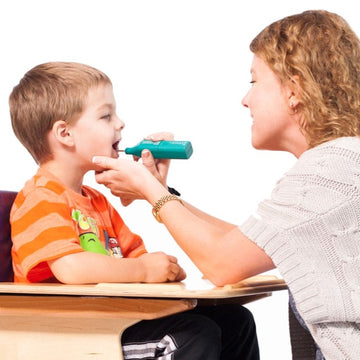
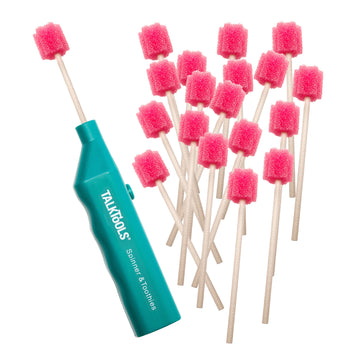
TalkTools® Spinner™ & Toothies™: Oral Sensory Diagnostic and Therapy Tool
A multifunctional oral sensory tool used by SLPs and feeding therapists to identify hypersensitivity, hyposensitivity, and tactile defensiveness in the oral cavity, and to improve sensory awareness and responsiveness as a preparation for oral placement, feeding, and speech therapy.
- The Spinner™ and Toothies™ serves dual clinical purposes: as a diagnostic tool to reveal oral sensory conditions, and as a therapy tool to improve sensory responsiveness in and around the oral cavity.
- As a diagnostic tool, it can reveal hypersensitivity, hyposensitivity, and tactile defensiveness, conditions that may interfere with oral placement therapy, feeding therapy, and speech therapy.
- It is commonly used as a sensory warm-up activity prior to therapy sessions, especially with clients who do not yet tolerate oral tools in their mouth, helping to build readiness before introducing more demanding therapeutic instruments.
- Effective for reducing “fixing”, atypical compensatory posturing of the jaw, tongue, or lips, by promoting greater oral cavity awareness and sensory processing.
- Kit includes 1 Spinner and 20 Toothies plus the original TalkTools® instruction booklet. Individual Toothies replacement packs are available separately.
- Clinically indicated for clients with Down syndrome, autism, cerebral palsy, dysarthria, apraxia, and other conditions where oral sensory processing affects speech, feeding, or swallowing.
The TalkTools® Spinner™ and Toothies™ operates as a dual-purpose oral sensory tool. Firstly, it diagnoses sensory-motor deficits in the oral cavity. Specifically, it reveals hypersensitivity, hyposensitivity, and tactile defensiveness. Furthermore, therapists use it therapeutically to improve oral sensory awareness and reduce “fixing.” Consequently, therapists commonly use it as a sensory preparation activity before oral placement therapy (OPT), feeding therapy, or speech therapy. For example, it helps clients who do not yet tolerate tools in their mouths.
Before a client can benefit from oral placement therapy, feeding therapy, or speech therapy, they must tolerate stimulation around the mouth. However, for many clients, this tolerance is not a given. Specifically, clients with autism, Down syndrome, cerebral palsy, or a history of aversive oral experiences struggle with this. Therefore, TalkTools® developed the Spinner™ and Toothies™ to address this exact clinical gap.
What Is the TalkTools® Spinner™ and Toothies™?
The Spinner™ and Toothies™ serves as TalkTools®’ original oral sensory tool. It features a motorized spinning handle, the Spinner, that accepts disposable sensory tips, the Toothies. Thus, it delivers controlled tactile stimulation to the lips, gums, tongue, and other oral structures.
TalkTools® designed it for two distinct but related clinical applications:
Key Clinical Concepts
Understanding “Fixing”
“Fixing” describes compensatory postural stabilization of the jaw, tongue, or lips in oral placement therapy (OPT). Specifically, a client uses atypical muscle contractions or bracing patterns. As a result, they compensate for inadequate motor control or sensory processing. Furthermore, fixing patterns can interfere with the precise oral movements. Consequently, clients struggle with clear speech production, safe swallowing, and efficient chewing.
The Spinner™ and Toothies™ helps reduce fixing by promoting greater awareness of the oral cavity. Additionally, it improves the quality of sensory information available to the client’s nervous system. Consequently, clients reduce their need for compensatory stabilization strategies.
Oral Sensory Profiles the Tool Can Identify
- Oral hypersensitivity: This represents an overreaction to oral sensory input. For instance, the client may gag, pull away, or become distressed. Specifically, they react when you introduce any tool or texture to the mouth area. Therefore, hypersensitive clients generally need a carefully graduated desensitization approach. They need this before direct oral therapy can begin.
- Oral hyposensitivity: This involves underresponsiveness to oral sensory input. For example, the client may have reduced awareness of food in the mouth. Additionally, they might drool without noticing or face difficulty grading the pressure of oral movements. Consequently, hyposensitive clients often benefit from increased sensory input. This input helps them improve oral awareness and motor coordination.
- Tactile defensiveness: This relates to an aversive response to tactile input. Furthermore, it may be more broadly based than hypersensitivity. For instance, the client may react defensively to light touch on the face or around the mouth. As a result, introducing any oral tool or texture becomes challenging. Thus, they require prior sensory preparation.
How the Spinner™ and Toothies™ Works
The Spinner
The Spinner operates as a battery-operated rotating handle accepting the Toothies tips. Notably, its rotation delivers controlled, consistent, gentle tactile stimulation. Furthermore, this stimulation differs distinctly from direct pressure tools. Additionally, it produces a unique sensory input. Consequently, many clients tolerate this more readily than static touch. More importantly, the spinning motion can reduce tactile defensiveness effectively. This happen through repeated, graded exposure.
The Toothies
Clinical Context of the Toothies
The Toothies act as disposable tips that attach to the Spinner. Consequently, each Toothy delivers a specific type of tactile input based on its surface texture. Additionally, the kit includes 20 Toothies. Moreover, you can purchase replacement packs of 20, 100, or 250 separately. As a result, this enables ongoing clinical use with appropriate infection control protocols.
In Oral Placement Therapy, therapists often introduce the Spinner and Toothies first in a session. Specifically, they use it before bite blocks, straw kits, or other direct oral work. Therefore, it functions as a sensory “bridge”. For example, it helps the client’s nervous system shift from a defensive state into a state of readiness. As a result, this prepares them for more targeted oral motor work. Furthermore, many therapists describe it as the essential tool. Simply put, it makes other tools possible for their most sensitive clients.
Clinical Populations
Ideal Candidates for the Spinner & Toothies
Therapists use the Spinner™ and Toothies™ across a wide range of clinical populations. Therefore, it proves especially well-suited for:
- Children and adults with Down syndrome, where reduced oral muscle tone and hyposensitivity frequently co-occur, making sensory stimulation a core component of both feeding and speech therapy
- Autistic clients. Furthermore, they may have significant oral tactile defensiveness or hypersensitivity. As a result, standard oral therapy tools become intolerable without prior sensory preparation
- Clients with cerebral palsy. Specifically, their oral motor control challenges often combine with sensory processing differences. Thus, these differences affect feeding and speech
- Children with feeding aversions or ARFID features. For example, building oral comfort and reducing tactile defensiveness acts as a prerequisite. Therefore, this helps in expanding food acceptance
- Clients with dysarthria or apraxia of speech. Moreover, improving their oral sensory awareness supports more precise motor planning. Consequently, this enhances their execution
- Any client who does not yet tolerate tools in the mouth. Therefore, TalkTools® designed the Spinner™ and Toothies™ specifically for them. Ultimately, it serves as a gentle, approachable entry point for oral sensory work
What Is Included in the Kit?
Kit Components Overview
- 1 Spinner (battery-operated rotating handle, AA batteries not included)
- 20 Toothies (disposable sensory tips)
- Original TalkTools® instruction booklet with clinical guidance and usage protocols
You can purchase replacement Toothies separately in packs of 20, 100, or 250. Consequently, this enables sustained clinical use. Furthermore, it allows you to follow appropriate single-use infection control protocols.
Use Within the OPT Program
The OPT Framework Integration
The OPT Introduction Kit includes the Spinner™ and Toothies™ in TalkTools®’ OPT Introduction Kit and making it a standard component of the full OPT Program. Within the OPT framework, it occupies a specific and important role. For instance, it acts as the tool establishing oral readiness. Consequently, therapists use it before introducing any other therapeutic tools.
For clinicians using TalkTools®’ structured therapy hierarchies, the instruction booklet provides essential guidance. Specifically, it explains how to integrate the Spinner™ and Toothies™ into session sequencing. Furthermore, it teaches how to interpret client responses diagnostically. Additionally, it shows how to grade intensity for hypersensitive clients. Finally, it demonstrates how to structure the transition from Spinner use to direct oral motor work.
Frequently Asked Questions
How does the Spinner™ and Toothies™ identify oral hypersensitivity?
Can the Spinner™ and Toothies™ be used as the only oral sensory tool?
Are the Toothies disposable or reusable?
Is the Spinner™ and Toothies™ appropriate for adults as well as children?
How does the Spinner™ and Toothies™ relate to feeding therapy for children with ARFID?
- TalkTools®. Spinner™ and Toothies™ product page. talktools.com
- TalkTools®. Introduction to OPT Kit. talktools.com
- Rosenfeld-Johnson, S. Oral Placement Therapy for Speech Clarity and Feeding. TalkTools®.
- ASHA Practice Portal: Pediatric Feeding and Swallowing. asha.org