
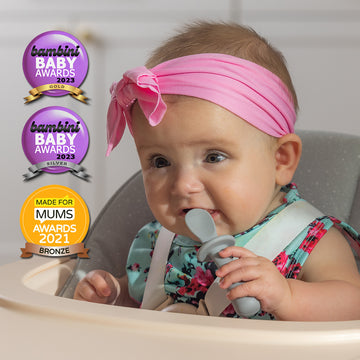
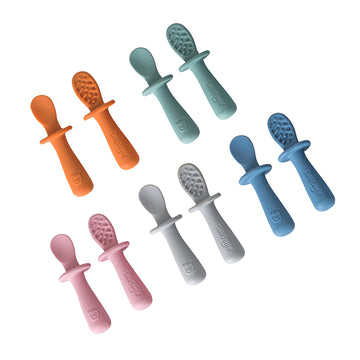
TalkTools® Itsy™ Spoons: Textured & Smooth Self-Feeding Training Spoons
Two clinically designed silicone spoons, one textured, one smooth, developed by SLP-OT teams to meet infants and toddlers at each stage of self-feeding development, including children with sensory and developmental differences.
- First, the Itsy™ Spoon Set includes two spoons: a Textured Spoon with a grooved bowl for added sensory input, and a Smooth Spoon for children who are more orally sensitive or earlier in their feeding journey.
- Furthermore, the flexible but sturdy silicone bowl allows for safer self-feeding. Meanwhile, the guard flange includes a stop-roll feature that keeps the bowl elevated above the eating surface when set down.
- Additionally, the symmetrical, bulb-shaped handle is proportionally designed to encourage independent grasping and holding, thereby supporting fine motor development alongside oral motor progress.
- Moreover, they are made from 100% LFGB platinum-grade silicone, making them free from BPA, BPS, PVC, and phthalates. Consequently, they are dishwasher-safe and microwave-safe.
- Finally, they are part of the Itsy™ Collection alongside the Itsy™ Cup and Itsy™ Plate, meaning they are designed to work as an integrated therapeutic self-feeding system.
The TalkTools® Itsy™ Spoons are a set of two clinician-designed soft silicone spoons, one textured and one smooth, developed to support the baby-led weaning and self-feeding journey. Specifically, they are designed to accommodate children at different stages of sensory and oral motor development. Therefore, they have a particular focus on infants and children with sensory processing differences, developmental delays, or other challenges that affect independent feeding.
Introduction: The Importance of Self-Feeding Tools
Self-feeding is undoubtedly one of the most meaningful developmental milestones a child reaches, and the tools used in that journey matter significantly. For instance, the TalkTools® Itsy™ Spoons were explicitly designed by the same SLP-OT teams behind the Itsy™ Cup. Ultimately, the goal was giving every child an appropriately therapeutic pathway to independent spoon use.
What Are the TalkTools® Itsy™ Spoons?
Essentially, the Itsy™ Spoon Set is a two-piece therapeutic spoon system that inherently addresses the reality that no two children arrive at self-feeding from the same place. As a result, each spoon is carefully designed for a distinct sensory and developmental profile:
Both spoons share core design features engineered for therapeutic feeding goals, not just consumer convenience.
Key Design Features
Guard Flange with Stop-Roll Feature
The guard flange is certainly one of the Itsy™ Spoon’s most practically useful features. Specifically, it performs two functions simultaneously: first, it acts as an anti-choking guard, preventing a child from inserting the spoon too deeply into the mouth. Second, it includes a stop-roll design that naturally elevates the bowl above the eating surface when the spoon is set down. Consequently, this keeps the bowl clean and food-safe between bites.
Flexible but Sturdy Bowl
Furthermore, the silicone bowl effortlessly flexes on impact, significantly reducing the risk of injury from spoon-to-mouth contact during early self-feeding attempts. At the same time, it maintains enough structural integrity to optimally support scooping and loading food. Indeed, this is a delicate balance that purely flexible consumer spoons often fail to achieve.
Symmetrical Bulb-Shaped Handle
Additionally, the handle is proportionally scaled for small hands and shaped symmetrically so that it can be easily grasped in either hand and in multiple orientations. Therefore, it successfully accommodates the varied and often unpredictable grip strategies of young children developing independent feeding. Moreover, the non-slip surface consistently maintains grip during wet or messy feeding sessions.
Clinical Applications for SLPs and OTs
As a matter of fact, the Itsy™ Spoons are frequently used by SLPs and OTs across a wide range of therapeutic feeding contexts:
Sensory Grading in Feeding Therapy
Importantly, the two-spoon system fully supports sensory grading, which is a core principle in feeding therapy where sensory input is systematically titrated to match the child’s current tolerance and then gradually expanded. For instance, a therapist might strictly begin with the Smooth Spoon for a child with oral hypersensitivity. Afterward, they can introduce the Textured Spoon once the child has successfully built tolerance for the feeding tool and is genuinely ready for enhanced sensory input.
Supporting Baby-Led Weaning
Baby-led weaning (BLW) is an approach to introducing solid foods in which the infant self-feeds from the start. The Itsy™ Spoons are designed with this approach in mind, the proportional sizing, flexible bowl, and anti-choking flange all support safe, independent spoon use from the earliest stages of BLW.
Oral Motor Feeding Goals
For children working on specific oral motor feeding goals, such as lip closure on a spoon, tongue elevation for clearing the bowl, or jaw stability during spoon acceptance, the Itsy™ Spoons provide a consistently-sized, consistently-shaped tool that enables repeated practice across sessions.
Having two spoons with different sensory profiles within the same therapeutic system is clinically significant. It allows a therapist to assess a child’s sensory response to different oral inputs using tools with an otherwise identical form factor, isolating the sensory variable rather than introducing confounds from different handle shapes, weights, or materials.
Who Benefits from the Itsy™ Spoons?
- Infants beginning baby-led weaning, from approximately 6 months of age when self-feeding readiness typically emerges
- Children with oral hypersensitivity, who need a gradual, low-pressure introduction to spoon feeding using soft, non-threatening materials
- Children with oral hyposensitivity, who benefit from the additional sensory input provided by the textured spoon bowl
- Children with fine motor challenges, who benefit from the symmetrical, easy-grip handle and non-slip surface
- Children with autism, Down syndrome, or related diagnoses, where sensory differences or motor coordination challenges affect self-feeding independence
- Selective eaters or children with ARFID features, where familiarity and consistency of feeding tools is an important component of mealtime safety and trust
Materials and Safety
Both spoons in the Itsy™ Spoon Set are made entirely from LFGB platinum-grade silicone, exceeding FDA standards for food-contact materials. They are:
- Free from BPA, BPS, PVC, phthalates, and other potentially harmful substances
- Dishwasher-safe for easy and reliable sanitation
- Microwave-safe for warming food when needed
- Resistant to food odors and flavor transfer
- Durable for long-term therapeutic use
Frequently Asked Questions
Which spoon should I start with, textured or smooth?
Are the Itsy™ Spoons appropriate for tube-fed children transitioning to oral feeding?
At what age can the Itsy™ Spoons be introduced?
- TalkTools®. Itsy™ Spoon Set product page. talktools.com
- TalkTools®. Itsy™ Collection overview. talktools.com
- ASHA Practice Portal: Pediatric Feeding and Swallowing. asha.org
« Back to Glossary Index