


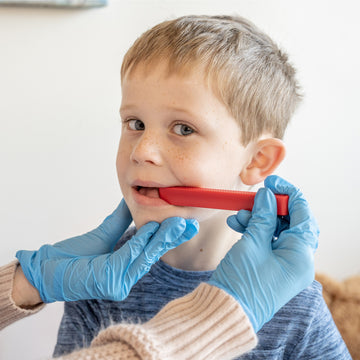


TalkTools® Jaw Grading Bite Blocks™: Isometric Jaw Training for Chewing and Speech
A clinician-designed bite-block hierarchy that trains jaw stability, symmetry, and graded movement at progressive jaw heights. Available in a standard Red set and a Sensory Friendly Purple set for texture-sensitive learners.
- Jaw Grading Bite Blocks use isometric holds at six progressive jaw positions (2 through 7) to build jaw stability and symmetry for chewing and speech.
- Available in two variants: Red (standard hard surface) and Purple (Sensory Friendly, softer material for texture-sensitive learners). Both follow the same six-position hierarchy.
- The hierarchy advances based on the quality of jaw control rather than a fixed timeline, making it adaptable to each learner’s progress.
- Designed for use by SLPs, OTs, and trained caregivers in clinic, school, or home settings under professional guidance.
- Part of the OPT Starter Bundle; complements the Bite Tube Set, Straw Kit, and Horn Kit within a complete OPT program.
TalkTools® Jaw Grading Bite Blocks™ are therapeutic instruments used within Oral Placement Therapy to develop isometric jaw strength, stability, and symmetry. Clinicians place the blocks on the molars at set jaw heights (positions 2 through 7) and cue sustained holds to train controlled, symmetrical jaw positioning. Available in a standard Red set and a Sensory Friendly Purple set for learners who are texture-sensitive.
What Are Jaw Grading Bite Blocks?
Consistent jaw positioning is a foundational skill for both eating and speaking. When jaw movement is uneven or unstable, children may struggle with chewing efficiency, lip closure, tongue positioning, and the precise oral movements needed for clear speech. To address this directly, TalkTools® Jaw Grading Bite Blocks™ were developed as a systematic, clinician-guided progression of isometric jaw exercises, available in two variants to match each learner’s sensory needs.
Jaw Grading Bite Blocks are a set of graduated therapeutic tools used within the TalkTools® Oral Placement Therapy (OPT) framework. Each block represents a specific jaw height, and the clinician guides the learner through isometric holds at those positions to build muscular endurance, positional awareness, and symmetrical jaw function.
Specifically, the blocks follow a hierarchy of positions 2 through 7, advancing based on the quality of control demonstrated rather than a fixed timeline. Additionally, an instruction booklet accompanies each set, covering setup, safety, and progression guidance.
Available Variants: Red and Purple
The Jaw Grading Bite Blocks are available in two variants that follow the same six-position hierarchy. Accordingly, the choice of variant is made by the clinician based on the learner’s sensory profile and response to oral input.

Red Set: Standard Jaw Grading Bite Blocks
The Red set features a firm, textured surface designed to deliver clear proprioceptive feedback during isometric holds. As a result, it is the standard clinical option for learners who tolerate typical oral input and is the most commonly used variant within OPT jaw programs.
Purple Set: Sensory Friendly Bite Blocks
The Purple set is made from a softer, sensory-friendly material that follows the same six-position hierarchy as the Red set. Consequently, it is specifically indicated for learners who are tactile-sensitive, find the standard red blocks uncomfortable, or need a gentler introduction to bite block training. In addition, the softer texture reduces sensory barriers to participation without changing the clinical goals of the program.
Why Jaw Stability and Grading Matter
Jaw stability is the jaw’s ability to maintain a controlled position against gravity and the forces of chewing or speaking, without unwanted lateral sliding, forward jutting, or asymmetrical drop. However, when this control is underdeveloped, the impacts are seen across both feeding and communication.
Impact on Chewing
Children with reduced jaw stability may have difficulty safely biting through foods with varying textures, moving food laterally across the molars, maintaining lip closure during chewing, and managing mixed textures. As a result, these challenges can restrict dietary variety and contribute to feeding-related stress at mealtimes.
Impact on Speech
The jaw provides the postural foundation for tongue and lip movements. Consequently, when the jaw is unstable or grading is imprecise, compensatory patterns can emerge including reduced intelligibility for consonants requiring specific jaw heights and inconsistent placement for sounds such as /s/, /z/, /sh/, and affricates.
Jaw Grading Bite Blocks require the clinician to cue active holds, monitor form, and observe for fatigue or lateral deviation in real time. In fact, the quality of each hold matters far more than the number of repetitions completed.
When used correctly within a comprehensive OPT program, bite block work creates reliable jaw positions that the tongue and lips can use as a stable base, which is exactly what is needed for both articulation and functional chewing.
How the Bite Block Hierarchy Works
Quick Start
- Review the instruction booklet and clinician’s plan before beginning any session.
- Select the variant (Red or Purple) and starting position based on the clinician’s assessment.
- Position the block on the molars and cue a gentle, sustained bite-and-hold with the head upright and posture stable.
- Keep holds brief and quality-focused. Discontinue immediately if the learner shows fatigue, discomfort, or asymmetry.
- Progress to the next position only when form is consistently stable, not on a fixed schedule.
- Integrate with other OPT tools such as the Bite Tube Set, Straw Kit, or Horn Kit as directed.
- Adult supervision is required at all times.
Watch: Jaw Grading Bite Blocks Overview
Care, Cleaning, and Safety
- Hand-wash between users with mild soap and warm water; rinse thoroughly and air-dry completely.
- Use the TalkTools Cleaning Kit for thorough disinfection in clinical or multi-user settings.
- Inspect all components regularly for cracks, wear, or damage. Replace immediately if any are found.
- Store away from young children when not in active use.
Frequently Asked Questions
What is the difference between the Red and Purple sets?
What does “jaw grading” mean?
How are Bite Blocks different from Bite Tubes?
Which starting position should be used?
Are Bite Blocks available in a bundle?
- TalkTools®. Jaw Grading Bite Blocks (Red). talktools.com
- TalkTools®. Sensory Friendly Bite Blocks (Purple). talktools.com
- Rosenfeld-Johnson, S. Oral Placement Therapy for Speech Clarity and Feeding. TalkTools®.
- TalkTools®. OPT Starter Bundle. talktools.com